
Glastonbury
Where the Mists Whisper Old Magic
There is a place in the green hills of Somerset where myth, magic, and mystery converge. This is Glastonbury, the ancient isle of Avalon, steeped in mysticism, and ancient lore, its sacred sites weaving together Christian, pagan, Arthurian, and goddess traditions. It is a land that still sings with fae voices and ancient myth.
To walk the land of Glastonbury is to enter a living myth, a sacred landscape that holds the stories of the goddess, the Christ, the dragon lines, and the deep waters of the soul. Among its many treasures, three places stand as luminous thresholds: the Tor, the White Spring, and the Chalice Well Gardens. Each one offers its own initiation, its own mystery, its own sacred medicine.
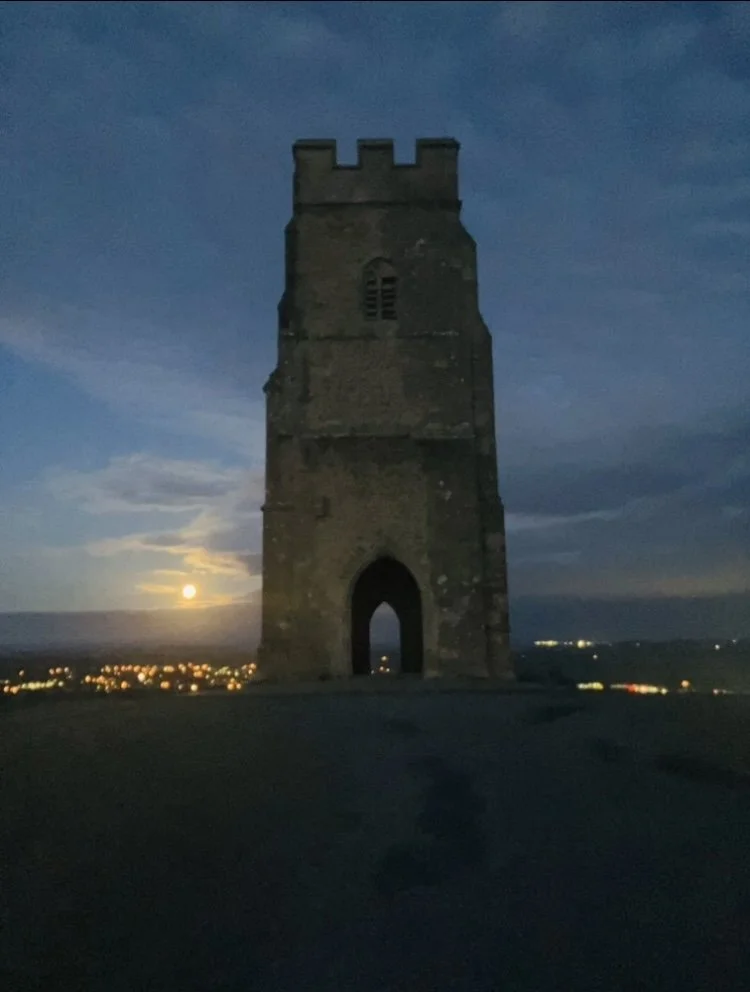
The Tor: A Hill Between Worlds
The Tor, rising dramatically from the Vale of Avalon is a hill crowned by the remnants of St. Michael’s Tower. Legends say the Tor was once surrounded by water, a mystical isle in the mists. A land where priestesses and goddesses walked.
In the myths, the Tor is a gateway between worlds. In Celtic tradition, it is the entrance to Annwn, the Welsh Otherworld – the land of the fae, ruled by Gwyn ap Nudd, the faerie king and lord of the Wild Hunt. He is said to reside in the Tor itself, guarding the veil between the living and the dead.
For others it is the Throne of the Goddess, a mound shaped like the swollen belly of Earth Herself, where energy spirals in sacred geometry.
The spiral terraces encircling the Tor are believed by some to form a ritual labyrinth, a path of sacred ascent, a physical mirror of the spiritual journey. At the top, winds whisper ancient names: Arthur, Gwyn ap Nudd, Morgana, Rhiannon, guardians of Avalon, keepers of mysteries.
Many believe Avalon itself, the mystical isle said to be home of Morgana le Fay and priestess of the Old Ways, is not a place lost to history, but a realm that coexists with ours, accessible through altered perception or dreams.
The Michael and Mary ley lines, rivers of Earth energy, cross beneath the Tor - the sacred masculine and feminine in divine embrace. At the foot of the Tor flow two sacred springs, their waters as different as day and night.
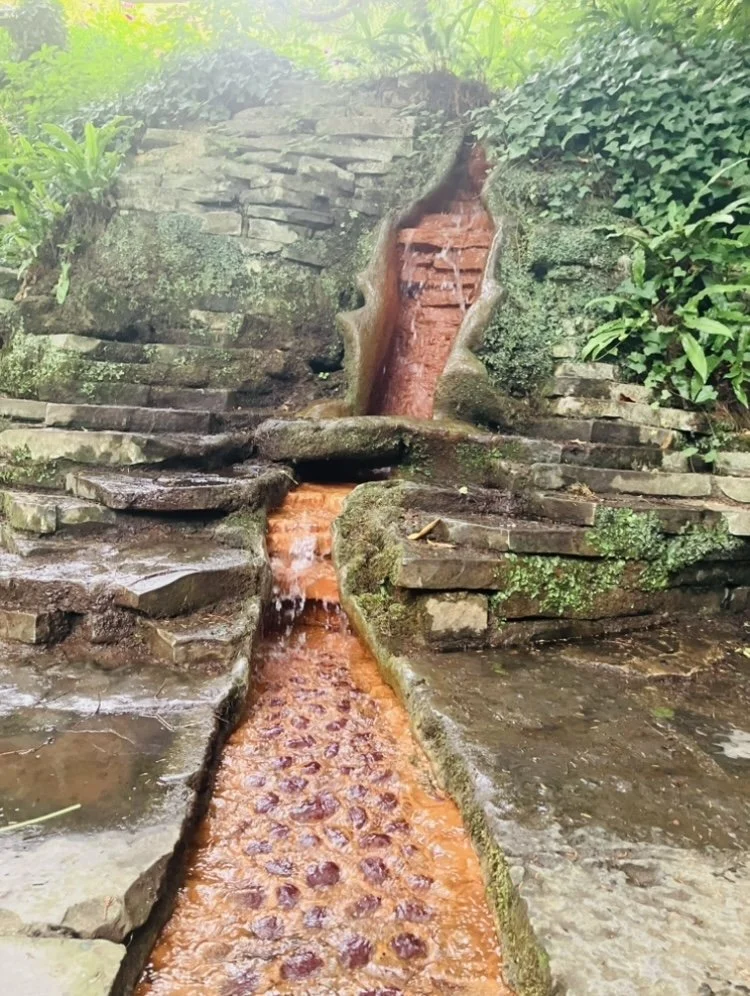
The Red and White Springs – Wells of Life and Mystery
At the base of the Tor, nestled in shadow and silence, lies the White Spring. A sanctuary carved into stone and lit by flickering candles on altars.
The White Spring’s waters run rich with calcite, minerals, and ancient origin, pouring forth like moonlight, a symbol of purity, spirit, and renewal. It is said to carry the essence of the divine masculine.
The Red Spring, rich with iron, runs like liquid fire, a symbol of blood, passion, and sacrifice. Both springs flow side by side, they flow, eternal opposites in harmony. Some say they are the lifeblood of Avalon itself, the balance of masculine and feminine, of earth and sky, of mortal and divine. Those that drink from both may taste the alchemy of wholeness, as though the springs themselves weave a blessing into body and soul.
The White and Red Springs are often seen as the physical outward flow of Avalon’s faerie energies. The red waters are the blood of the Goddess, the fae queen, the rose of life. The white waters are the light of the sidhe, supernatural beings from Irish and Scottish mythology – cool, crystalline, and otherworldly.
Together they represent the unified energy of the faerie realms, magic and medicine, dream and devotion, fire and water.
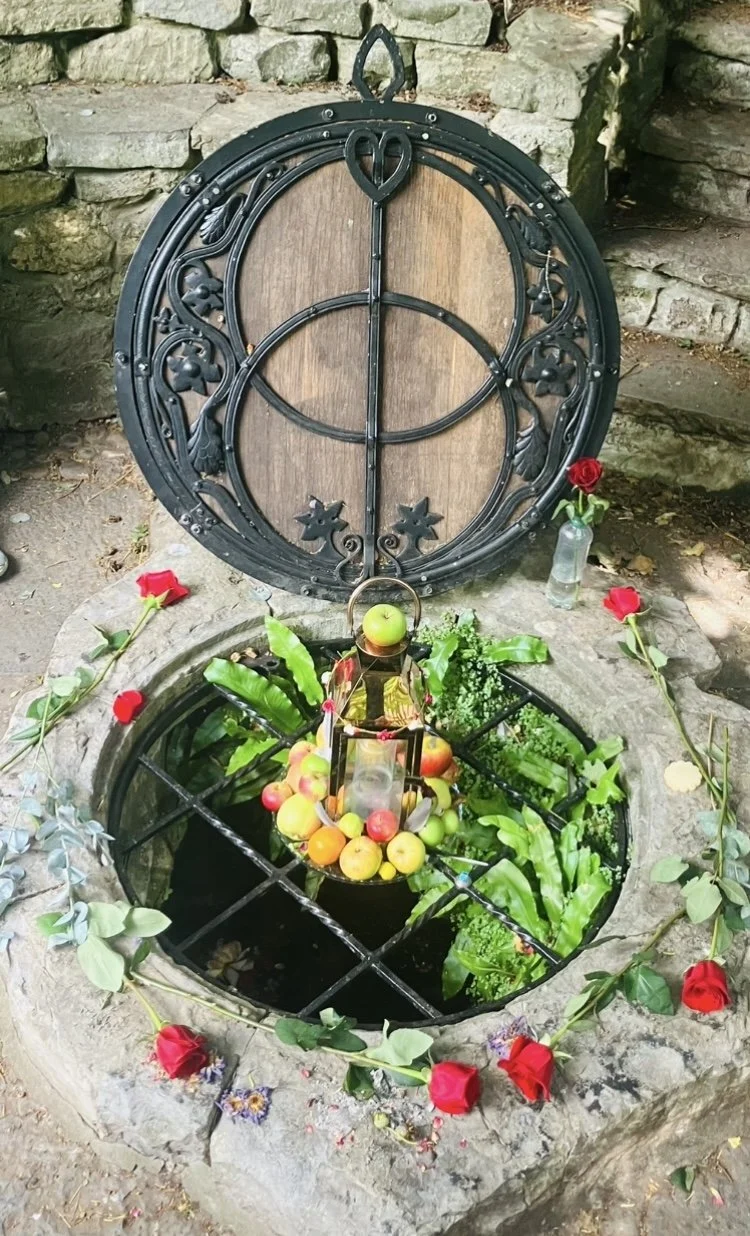
The Chalice Well Gardens
Just across the path from the White Spring, is the Chalice Well Gardens. A sacred sanctuary centred around one of the most revered holy wells in Britain. It is an ancient Holy Spring, and the well has been flowing continuously for thousands of years, never running dry. It is estimated to be over 2,000 years old. Its waters run red with iron, symbolizing the blood of the Earth, the womb of the Goddess, and in Christian lore, the blood of Christ. Legend says that Joseph of Arimathea, the uncle of Jesus, brought the Holy Grail here after the crucifixion and buried it near the spring, causing the waters to flow forevermore. He is said to have buried the Grail near the well, and from it sprang the blood-red waters, symbolizing Christ’s sacrifice.
At the centre of the garden is the Vesica Piscis well cover, a sacred geometric symbol representing the union of opposites – the spirit and matter, masculine and feminine, solar and lunar.
The water flows through a series of seven sacred pools, each one representing a stage of spiritual cleansing and transformation. The Lion’s Head Fountain is a popular site for visitors to fill their bottles or cup their hands to drink from the healing waters.
Deeply rooted in both myth and mysticism, the Chalice Well is intimately tied to the legends of Avalon, the Holy Grail, and the Divine Feminine.
And of course, no mention of Glastonbury is complete without the legends of King Arthur, half-brother of Morgan le Fay. Tradition holds that Glastonbury Abbey was the final resting place of Arthur and his queen, Guinevere. According to medieval chroniclers, monks claimed to have uncovered their graves in the 12th century, cementing the town’s association with the legendary king.
Some modern Glastonbury legends weave Mary Magdalene into its rich tapestry of Christian and mystical lore, suggesting that after the Crucifixion she journeyed with Joseph of Arimathea to Britain.
What makes Glastonbury remarkable is how it embraces all these stories at once. It is the Avalon of Arthurian legend, the Holy Land of Joseph’s relics, and the sanctuary of Mary Magdalene’s wisdom. Avalon is not a distant otherworld, but a sacred landscape deeply connected to Glastonbury itself, a liminal place where the veil between worlds grows thin. To walk Glastonbury is to walk through your own mythology. It is to remember that the sacred is not a story of the past, but a living force in the present.